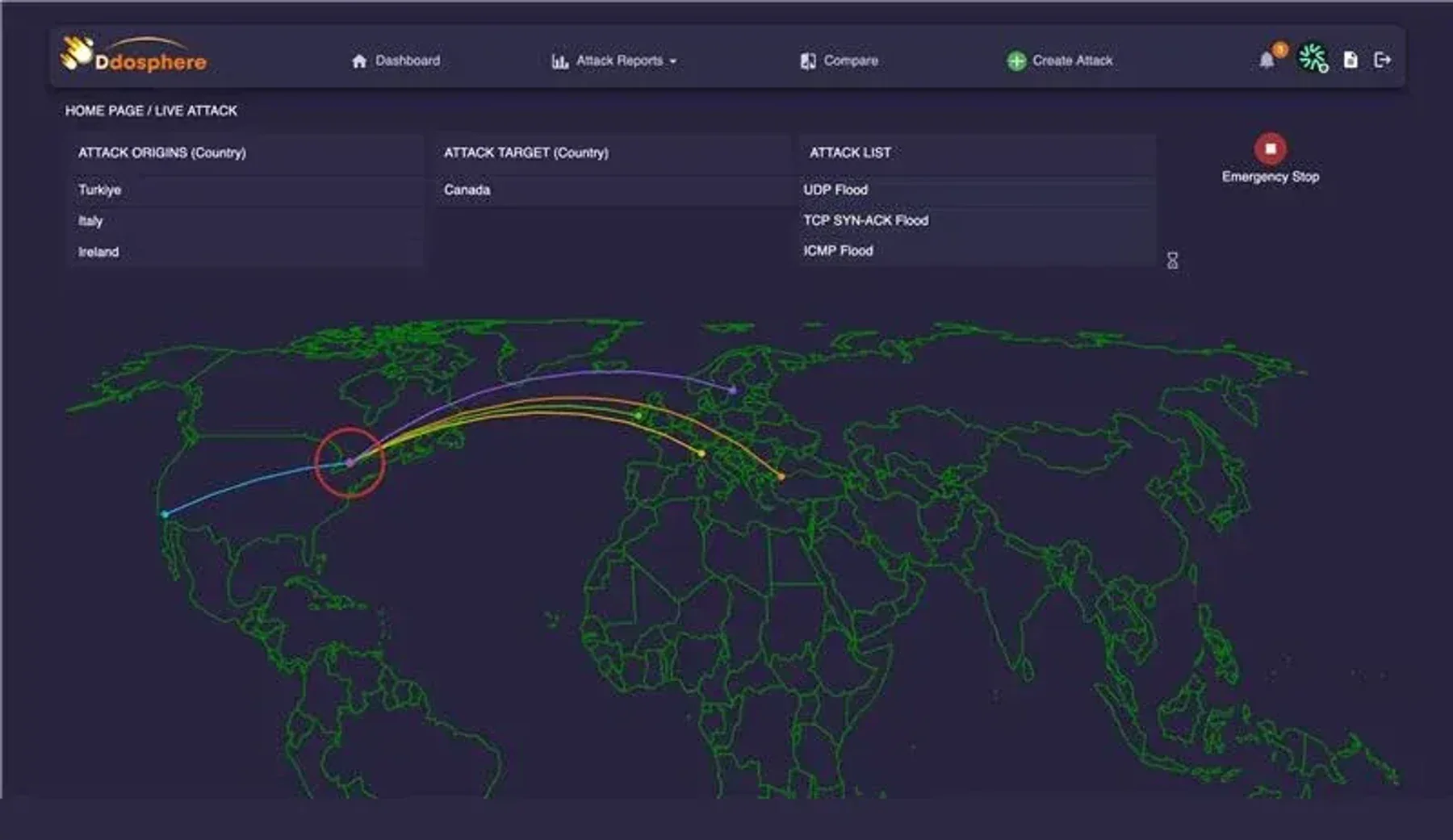
Ddosphere provides fast and configurable DDoS testing across five different attack intensity levels. It operates using TCP, UDP, and ICMP protocols and more to simulate real-world threats and measures performance based on key metrics such as BPS, PPS and TPS.
Ddosphere runs fast, configurable simulations at five intensity levels. Scope, thresholds and stop criteria are agreed before anything begins. The test proceeds under control and halts automatically once a defined threshold is crossed.
Real-world threat simulation
TCP, UDP, ICMP
Attack patterns encountered in the field are reproduced across three protocols. Traffic can be generated in a distributed way from different geographic regions, bringing test conditions closer to the distribution of a genuine attack.
Metric-based resilience measurement
BPS · PPS · TPS
Measurement is taken through bandwidth (BPS), packet (PPS) and transaction (TPS) metrics. Where the defence weakens is established by number rather than by estimate, and the result becomes a comparable resilience score.
Comparative analysis
Before and after
Results from different test conditions are set side by side. The effect of a security investment becomes visible as a number, and the claim that something improved rests on a measured difference.
Input for capacity planning
Infrastructure decisions
Measured data is produced for bandwidth and protection layer investment. The capacity conversation leaves the realm of instinct, and the budget request rests on a report.
Audit-ready reporting
Compliance evidence
Test scope, method, intensity levels and results are documented. The report can be presented as evidence in audit processes that carry a resilience testing obligation.
With Ddosphere, you prove your resilience on your own terms rather than under attack.
How it works
1
Define scope
Agree the systems to be tested, the target thresholds and the stop criteria together. Everything outside scope stays protected.
Who is it for?
Banking
Institutions where transaction continuity is mandatory and an outage creates both a revenue problem and a regulatory one.
E-commerce and retail
Businesses whose revenue depends directly on the site, and whose attack surface grows alongside traffic during campaigns.
Telecommunications
Operators where network resilience determines subscriber experience and service commitments directly.
Public sector and critical infrastructure
Institutions where an outage affects service access and public confidence.
Aviation and travel
Operations where the booking infrastructure is the revenue gateway and sales stop the moment it does.
What Changes?
Before
With Ddosphere
Defence effectiveness learned during the first real attack
Measured in advance through controlled simulation
Generating a realistic attack scenario carries risk
A test with defined scope, thresholds and a stop switch
Bandwidth limits and weak points unknown
Resilience measured through BPS, PPS and TPS
Compliance evidence gathered by hand
Audit-ready reports generated automatically
A purely reactive security posture
Proactive validation before the risk materialises
Built for high-risk digital environments.
Proven experience in industries where the cost of a performance failure is highest.
Does DDoS simulation put my production systems at risk?+
Test scope, intensity level and stop thresholds are defined together before anything starts. The simulation is applied only to systems in scope and halts automatically when a threshold is crossed. The test window and the teams to be notified are planned in advance, and the process runs under control.
Which attack types can be simulated?+
Ddosphere runs simulations at five intensity levels across the TCP, UDP and ICMP protocols. Traffic can be generated in a distributed way from different geographic regions. Measurement is taken through BPS for bandwidth, PPS for packets and TPS for transactions.
Can the results be used in compliance audits?+
Ddosphere produces a report documenting test scope, method, intensity levels and results. That report can be presented as evidence in audit processes carrying a resilience testing obligation. The format and scope your auditor expects are clarified up front in the project.
How long does a test take and how often should it be repeated?+
A single simulation scenario usually completes within hours. The common approach is to repeat the test after a significant infrastructure change and ahead of high-traffic periods. Repeating it regularly lets you see the effect of your defence investments comparatively.
What is the difference between DDoS simulation and penetration testing?+
Penetration testing investigates whether unauthorised access to a system is possible. DDoS simulation measures whether the system stays up under heavy traffic. They cover different risks and do not substitute for each other; for resilience validation they should be planned together.
References
Validate your defences before the attack arrives
Complete the form and we will discuss your externally facing services, your critical business flows and your current defence layers. A controlled simulation will show you which layer engages, and where.